Share It On:
 Stop gambling with your brand’s visibility. Choose between the in-house vs. agency marketing based on their costs, benefits, and scalability to secure your market share.
The choice between in-house vs. agency marketing models is often the line between a business that stagnates and one that scales. At some point, every leader faces this hurdle: do you invest in the long-term culture of an internal department, or do you plug into the immediate, high expertise of an outside firm?
An internal team offers unmatched brand understanding, while an agency provides a multidisciplinary force that can pivot as fast as digital marketing trends shift. In the following sections, we break down the critical differences in cost, expertise, and scalability to help you identify which model fits your current lifecycle. If you’ve been struggling to decide where to put your capital, this comparison serves as your final roadmap.
In-House Marketing Team vs. Agency: Key Differences
Choosing between these two models isn't just about budget; it’s about how you want your business to function. An in-house team is a long-term bet on your brand’s internal culture, while an agency is an on-demand requirement designed for performance and scale.
Below is a breakdown of how these two paths differ across the most critical business factors:
| Factor | In-House Marketing Team | Digital Marketing Agency |
|---|---|---|
| Brand Immersion | Your team understands the "why" behind every product update | Agencies offer a bird's-eye view and bring cross-industry insights that stop your brand |
| Financial Setup | You’re paying for salaries, taxes, office space, and benefits | You pay a fixed retainer or project fee |
| Skill Depth | One person handles SEO, social media, and content marketing strategy | Get a full dedicated SEO leads, PPC masters, and marketing experts |
| Speed to Market | Campaigns take longer to plan because of limited hands on deck | Have the systems to launch complex app marketing strategies in days |
| Tech & Tools | Buy and manage your own digital marketing tools | Benefit from the high-end tools without paying the individual licensing fees |
| Scalability | To scale, you have to recruit, interview, and onboard. This can take months | Can shift resources and add team members to your account instantly to meet the demand |
| Cost | $240,000 – $600,000+ | $12,000 – $150,000+ |
What is In-House Marketing?
In-house marketing is all about building your own internal powerhouse. Instead of hiring a firm, you recruit a dedicated group of specialists who live and breathe your brand 24/7. These are your direct employees, people who sit in your Slack channels (or your office) and report straight to your internal leadership.
Usually, the structure kicks off with a CMO or a Marketing Lead who manages a tight-knit crew of experts in content marketing, social media, and PPC advertising. Most companies pull the trigger on this model when they can't compromise on brand intimacy. It’s for those who have the runway to invest heavily in long-term business growth and want every single team member to focus solely on their own bottom line.
In-House Marketing Cost Structure
When you bring marketing under your own roof, you are essentially launching a new department with its own set of liabilities. You have to account for the fully loaded cost of every hire. The table below shows the different pricing estimates for hiring an in-house marketing team.
| Cost Category | Annual Cost | What Does It Cover? |
|---|---|---|
| Core Talent | $40k – $450k | This covers a 3-person team (Manager, Content/SEO, Paid Media) |
| Recruitment | $6k – $25k+ per hire | External recruiter fees often hit 15% to 30% of the first-year salary |
| Benefits & Taxes | $45k – $112k | Statutory benefits, 401 (k), and payroll taxes add a 35% to 54% premium on top of every salary |
| Software & Tools | $6k – $15k | This covers premium tools for SEO, analytics, and CRM |
| Training & Dev | $3k – $7k | This covers paying for certifications and workshops to keep internal skills from becoming obsolete |
What Does it Mean to Hire a Digital Marketing Agency?
Think of a digital marketing agency as an elite ‘special ops’ team you hire to handle the heavy lifting. This is an external partner staffed with specialists who manage multiple accounts across various niches. They offer a ‘plug-and-play’ setup that gives you instant access to everything, from sophisticated app marketing strategies to cutting-edge AI for SEO workflows.
You would typically lean on an agency when you need to move the needle fast but don't want the headache of a massive internal payroll. Agencies are forced to stay ahead of the curve with Generative Engine Optimization (GEO) and other tech shifts because their survival depends on being sharper and faster than a standard generalist team. It’s the go-to move for those looking to skip the recruitment phase and jump straight into execution.

Digital Marketing Agency Cost Structure
Hiring an agency is often the most efficient way to access a high-performance marketing engine without the long-term baggage of an internal department. Instead of paying for seats, you are paying for output. You also gain the benefit of their enterprise-level software without paying the thousands of dollars in subscription fees. This is a lean, variable-cost model that allows you to scale your spending up or down based on your actual business needs.
| Cost Category | Annual Cost | What Does It Cover? |
|---|---|---|
| Core Talent | $12k – $144k | A full team of marketing professionals will work on the project |
| Recruitment | Zero | The agency manages its own hiring and turnover internally |
| Benefits & Taxes | Zero | Your monthly fee is all-in with no additional employer taxes |
| Software & Tools | Included | Agencies provide the tech stack as part of their service fee |
| Training & Dev | Zero | Agencies invest in their own upskilling to stay competitive in the market |
Advantages of In-House Marketing
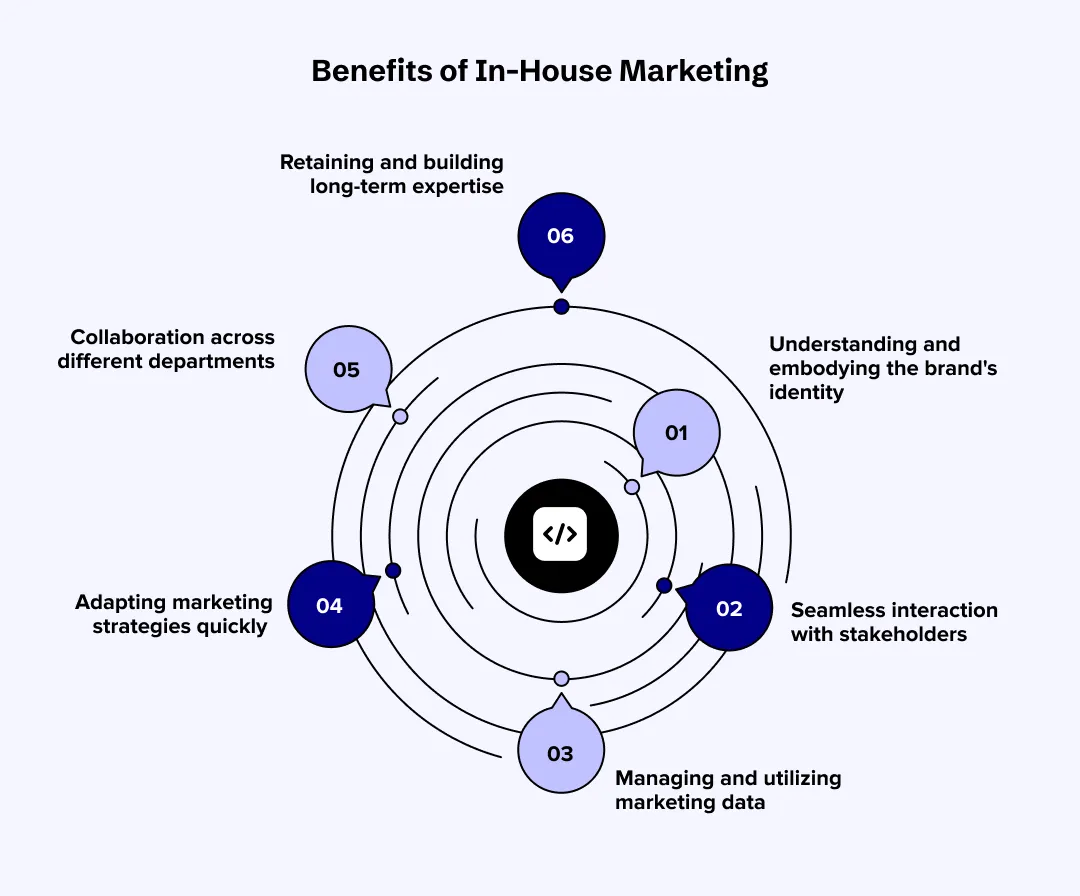
There is a strategic reason why industry titans choose to keep their creative and analytical engines close to home. The advantages of in-house marketing aren't just about saving on agency markups; they revolve around deep-seated speed and cultural alignment. When your marketing team is part of your company's DNA, the energy between digital marketing strategies, product development, and promotion becomes seamless.
Here is a detailed look at why building an internal department can be a game-changer for your business:
1. Deep Brand Familiarity and Cultural Alignment
No external partner, regardless of their talent, will ever grasp your brand’s soul like someone who lives it 30-40 hours a week. An in-house team understands the subtle nuances of your brand voice, the inside jokes, the historical failures, and the long-term vision. This relationship is crucial when you need to market to Gen Z, a generation that sniffs out inauthenticity in seconds. Your internal staff doesn't just read a brand guideline; they help write it.
2. Direct Communication and Zero Latency
In a fast-moving market, waiting 24 hours for an agency status update or a scheduled sync can be a horrifying experience for a campaign. With an internal setup, you eliminate the need for an account manager. If a PR crisis hits or a high-priority feature launches unexpectedly, your team is right there in your channels or in the office.
3. Full Control Over Data and Processes
Data is the new oil, and keeping it in-house is about security and strategy. When you own your CRM marketing stack entirely, there is no risk of losing institutional knowledge if you part ways with a vendor. You have 100% transparency over your first-party data, customer behaviors, and conversion funnels. This total ownership allows you to build proprietary marketing strategies to grow business without worrying about third-party data leaks or fragmented reporting.
4. Agile Customization and Pivot Ability
Agencies are bound by Scope of Work (SOW) documents. If you want to change directions mid-month, you often face change request fees or contract renegotiations. Internal teams give you the freedom to pivot your content creation strategy on a dime. Whether it’s jumping on a viral trend or pausing a campaign that isn't hitting the mark, you have the ultimate flexibility to reallocate resources without checking a contract first.
5. Cross-Departmental Synergy
Your marketing team doesn't work in a vacuum. By being in-house, they can walk over to the sales or product team to understand exactly why users are churning or what features are most requested. This internal collaboration ensures that your marketing product isn't just pretty, but is functionally aligned with what the sales team needs to close deals.
6. Long-Term Institutional Knowledge
Agencies have high turnover; your star account manager might be gone in six months. An in-house team builds a repository of what has worked and what has failed specifically for your brand over the years, not just months. This historical context prevents you from making the same expensive mistakes twice and ensures that your marketing efforts are always building on a solid foundation.
In-House Marketing Challenges
Building an internal powerhouse is rewarding, but it’s far from easy. If you aren't prepared for the logistical and financial hurdles, the in-house marketing challenges can quickly eat away at your ROI. Managing a department is a full-time job in itself, and the risks often hide in the hidden costs of human resources and operational upkeep.
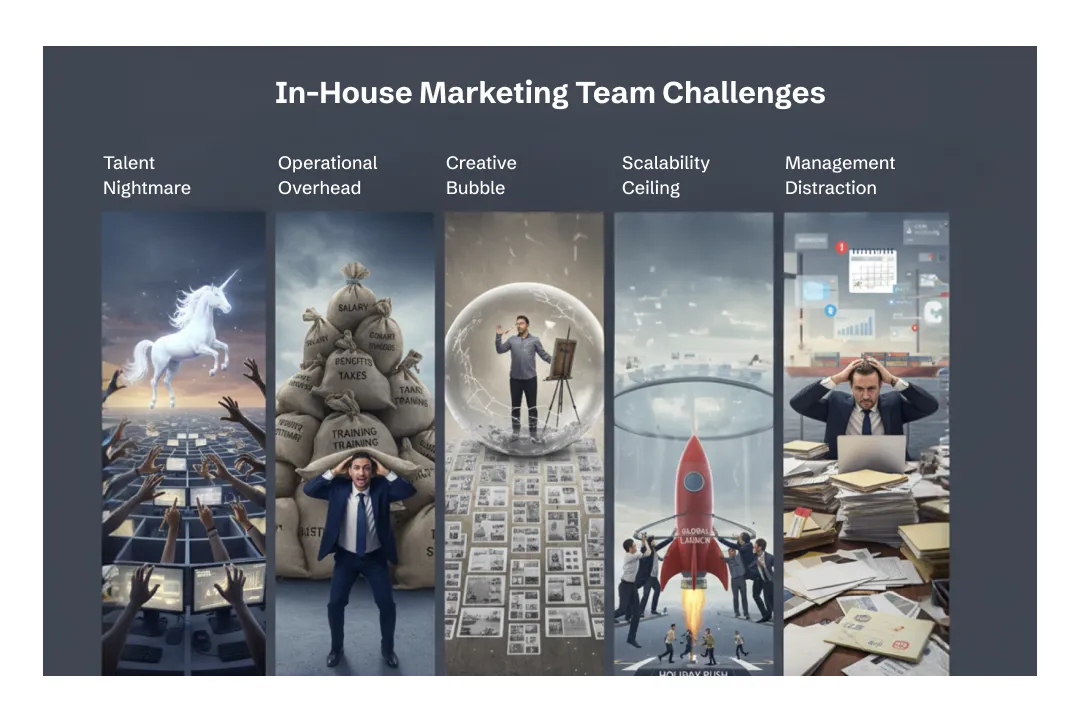
Here is what you are truly up against when keeping everything under your own roof:
1. The Talent Recruitment & Retention Nightmare
Finding a unicorn specialist who is equally skilled in AI in marketing, SEO, high-end design, and technical content marketing strategy is like searching for a needle in a haystack. Even if you land a top-tier expert, keeping them is a constant battle. In the tech sector, your best people are always being hunted by competitors with deeper pockets. If your lead strategist quits, your growth could grind to a halt for months while you scramble to find a replacement.
2. Crushing Operational Overhead
The price tag of an internal team goes way beyond their base salary. You’re on the hook for healthcare, retirement plans, office space, and hefty payroll taxes. Then there’s the tech stack. If you want to take your business seriously, you’ll need enterprise-grade digital marketing tools that carry massive monthly subscription fees. Plus, you’re the one paying for their constant training to stay on top of digital marketing trends; if you skip this, their skills will be outdated before the year is out.
3. The Creative Bubble Stagnation
One of the most silent but deadly in-house marketing challenges is the risk of your team becoming stale. When creative minds focus on just one brand for years, they often lose their edge. They stop noticing what’s working in other sectors and can become defensive about ‘how we've always done things.’ This tunnel vision results in repetitive campaigns that fail to excite a global audience, making your campaign strategies feel stagnant.
4. The Scalability Ceiling
What happens when you need to pull off a massive global launch or a sudden holiday push? Your internal team of five has a hard limit on the number of hours they can work. Unlike an agency, you can’t just dial up the headcount for a four-week sprint. This usually leads to extreme burnout, sloppy mistakes, and missed deadlines.

5. Management Distraction
Every hour you spend managing internal marketing squabbles, performance reviews, or hiring processes is an hour you aren't spending on your core business. For many CEOs, the time cost of managing an internal marketing department is the biggest hidden expense of all. You become an HR manager instead of a visionary leader, which can slow down your overall marketing strategies to grow your business.
Benefits of Hiring a Digital Marketing Agency
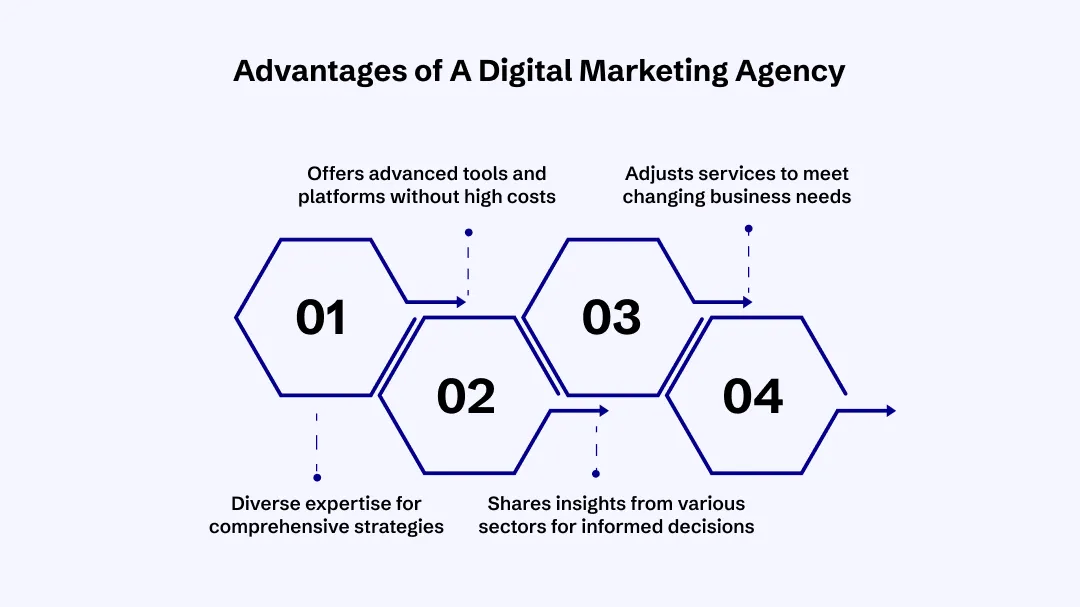
If the tough task of internal management sounds like too much to take on, partnering with an outside firm offers a high-octane alternative. The benefits of hiring a digital marketing agency lie in their ability to act as a force multiplier for your brand. You aren't just hiring help; you are buying a pre-built, high-performance engine.
1. Immediate Access to a Multidisciplinary Team
When you hire an agency, you get an entire department for the price of one or two mid-level employees. You get instant access to specialists in content marketing, PPC advertising, and complex app marketing strategies. You don't have to worry about training them; they are already masters of their craft, ready to execute from day one.
2. Leading-Edge Tech Without the Bill
Agencies invest a fortune in the latest software for Generative Engine Optimization (GEO) and Answer Engine Optimization (AEO). When you partner with them, you get the insights from these tools without having to pay for the licenses yourself. This gives your project a level of data-driven precision that’s hard to replicate on a DIY budget.
3. Industry-Wide Perspective
Because outsourcing marketing involves working with multiple clients across different markets, they have a macro view of the digital landscape. They know which lead generation trends are actually working and which are just hype. This cross-pollination of ideas means your brand benefits from winning tactics that were perfected elsewhere, keeping your content creation strategy fresh and competitive.
4. Scalability on Demand
One of the most underrated advantages of hiring an agency is the ability to scale your efforts up or down instantly. Need to launch a new site for a subsidiary? Or want to test why digital marketing is beneficial in a new country? An agency can shift resources and pull in extra talent to meet your deadline without you having to post a single job opening.
Disadvantages of Outsourcing Digital Marketing Agency
Let’s be honest: while hiring an outside firm can take a massive load off your shoulders, it isn’t always a perfect experience. Before you sign a long-term contract, you have to weigh the outsourcing digital marketing pros and cons with a cold, hard look at the reality of the partnership. An agency is a business with its own goals, and that means its way of working won't always mirror your internal hustle.
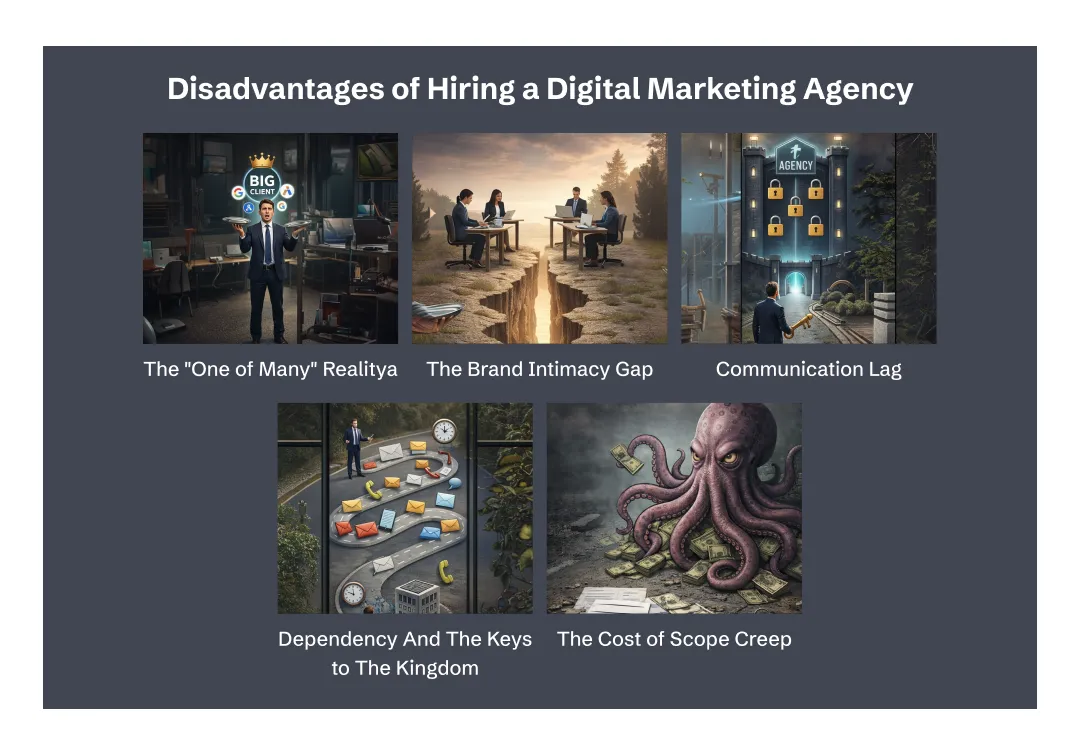
Here are the common roadblocks you’ll likely run into when outsourcing marketing:
1. The "One of Many" Reality
When you hire an agency, you aren't their only focus. Your account manager is probably juggling several other brands at the same time. This can lead to moments where you feel like just another ticket in their system. If a bigger client, someone spending triple your budget, has a sudden emergency, your content marketing strategy might get pushed to the back burner for a day or two.
2. The Brand Intimacy Gap
No matter how many onboarding calls you have, an agency doesn't live in your office. They aren't hearing the casual chats about product bugs or the direct feedback from your sales team. This distance can sometimes result in content that feels a bit generic or shallow. If your product is complex, you might spend more time correcting their technical errors than you would if you had an expert sitting right next to you.
3. Communication Lag and "Email Tag"
You can’t just walk over to an agency staffer’s desk for a quick question. Everything moves through formal channels, Slack, emails, or those dreaded weekly status calls. If you need a fast pivot on your email marketing best practices, you’re in the process of developing a strong email marketing team that understands the ongoing essentials of email marketing. This layer of bureaucracy can be a major trouble for founders who are used to making things happen instantly.
4. Dependency and the "Keys to the Kingdom"
This is a big one. Some agencies set up your ad accounts, pixels, or CRM marketing workflows inside their own proprietary systems. If the relationship turns sour, untangling your data can be a nightmare. You never want to find yourself in a position where you're locked into a partner because they own the access to your digital history. Always make sure you own your accounts from day one.
5. The Cost of "Scope Creep"
Agencies run on billable hours and specific contracts. If you suddenly want to explore AI in SEO but it wasn't in your original agreement, get ready for a change request and an extra bill. Unlike an internal team that just gets it done, agencies have to protect their margins, which can make them feel less flexible when you want to experiment with new digital marketing trends.
How to Decide: In-House vs. Digital Marketing Agency

Choosing between in-house vs. marketing agency models isn't a "one-and-done" decision. It’s a strategic move that should change as your company evolves. Don't let FOMO or flashy sales pitches lead the way; focus on your internal capacity and 12-month goals.
1. Evaluate Your Technical Needs
Is your marketing fairly standard, or do you need deep, specialized knowledge? If you're doing a high-level campaign, an agency that has done it twenty times before might be better than hiring one person and hoping they can figure it out on the fly.
2. Do the "Fully Loaded" Math
When comparing costs, don't just look at the salary. Factor in the office space, the high-end digital marketing tools, the benefits, and the time you'll spend managing them. Often, you’ll find that a marketing agency cost is actually much lower than the total overhead of a small internal department.
3. Consider Your Launch Speed
If you need to move now, an agency is the winner. They have the team ready to go. If you decide to go in-house, you’re looking at months of interviews, background checks, and onboarding before you see a single lead.
4. Think About a Hybrid Approach
Most successful brands you know don't choose just one. They hire a sharp in-house Marketing Manager to own the brand voice, then hire an agency to handle the technical heavy lifting, such as PPC advertising and staying on top of Generative Engine Optimization (GEO). This gives you the best of both worlds: brand intimacy and elite expertise.
The Final Strategic Choice: Internal Culture vs. External Power
At this stage, you aren't just comparing prices; you are choosing the partner that will power your brand’s future. If you have the capital and the time to cultivate a culture, building an in-house team provides a level of brand soul and data control that is hard to replicate. However, if you need to scale fast, bypass recruitment trouble, and tap into elite specialized talent without the massive overhead, hiring an agency is the definitive move.
The choice between an in-house vs. agency model depends entirely on your current appetite for risk and your need for speed. If you’re still feeling stuck, MobileAppDaily is here to bridge that gap. We specialize in helping leaders choose the right marketing agency by providing expert insights. Don't leave your growth to chance; pick the partner that actually fits your 12-month vision
Frequently Asked Questions
What defines the strategic choice between an in-house vs. agency model?
Speed is the deciding factor. Digital marketing agencies scale fast. This is one of the benefits of hiring a digital marketing agency for time-sensitive launches. In-house teams take months to build. They sometimes lack the right resource for a specific task.
What are the biggest in-house marketing challenges for tech firms?
Recruitment is a constant battle. Top talent is expensive. You also face heavy overhead from taxes. Choosing between an in-house vs. marketing agency depends on your ability to manage these rising internal costs. Internal staff require constant training to stay updated.
Are the advantages of in-house marketing worth the higher fixed costs?
Total brand control is the main perk here. Your team lives your values every single day. This depth of understanding is a key feature of an in-house marketing team vs. agency setup.
What are the primary marketing agency benefits for global enterprises?
Agencies offer specialized skills that are hard to find in one person. They stay ahead of technical shifts. This expertise is one of the main advantages of hiring an agency. You get scale without the friction of internal HR management.
Why should a firm prioritize an in-house vs. marketing agency structure?
Direct control is key. You manage every detail of the brand voice. These advantages of in-house marketing outweigh the costs for large corporations. You own the data. Internal teams work faster on small daily updates without waiting for external partner approvals.

Uncover executable insights, extensive research, and expert opinions in one place.
Related Content